
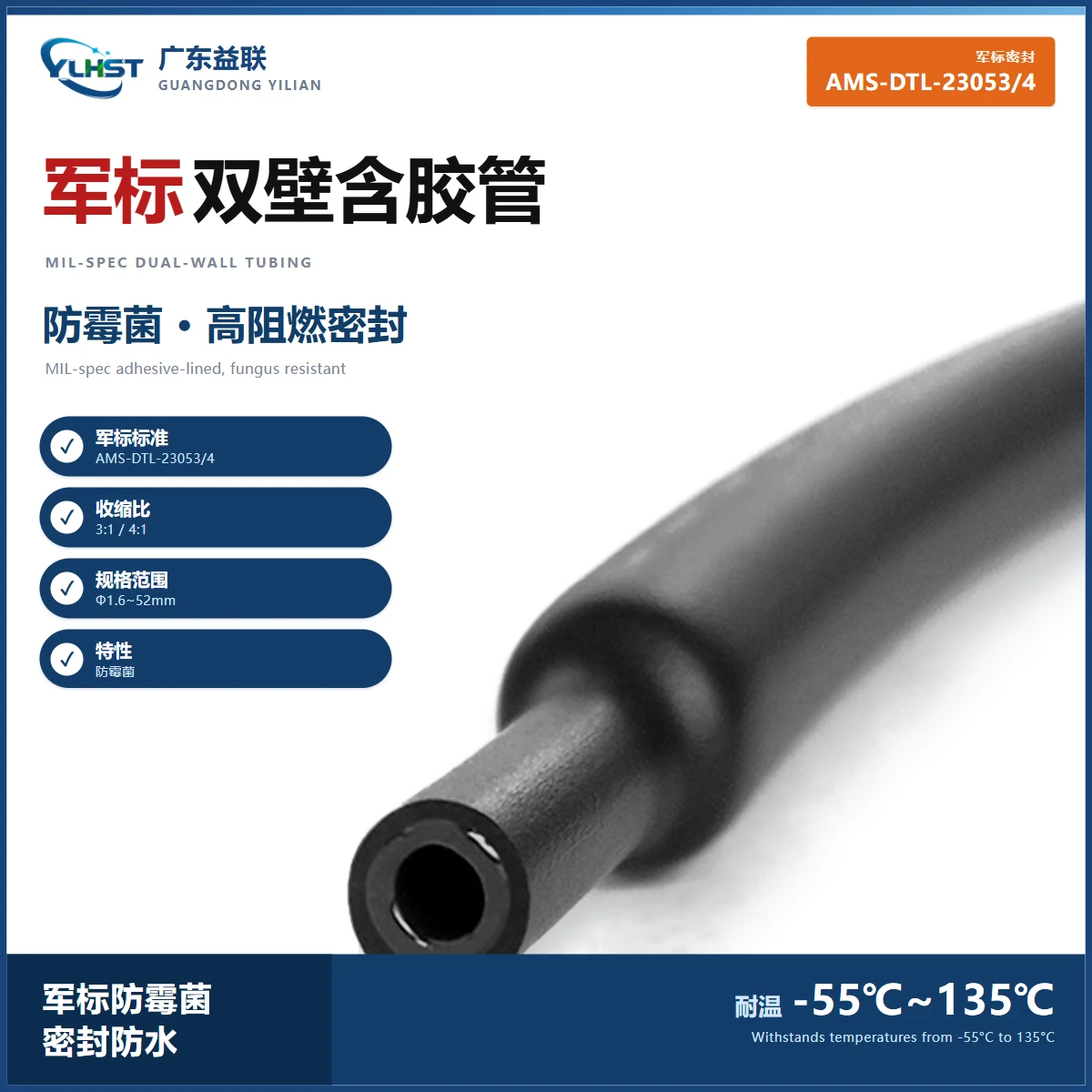
Size columns read like codes: Ø3.2, 4/1, 3:1. They answer two different questions. The diameter number tells you how large the tube is before heating; the ratio tells you how far it will close. Most field errors are diameter errors — too large and the tube never grips, too small and it will not pass over the terminal.
How sizes are written
Two conventions are common. Ø plus a number gives the nominal expanded inner diameter in millimetres, for example Ø3.2. A pair such as 4/1 gives the expanded and the fully recovered inner diameter, read as "four to one". The ratio (2:1, 3:1, 4:1) is the expanded ID divided by the recovered ID.
Remember the state: tubing in the store is expanded. The expanded diameter decides whether it slides on; the recovered diameter decides whether it grips.
Expanded and recovered diameters
Two rules cover selection. First, the expanded ID must be clearly larger than the cable outside diameter — a 10–30 % allowance is normal, and more when the joint includes a terminal or connector shell. Second, the recovered ID must be smaller than the cable insulation diameter so the tube grips without slipping. Ideally the cable OD falls between the two, closer to the recovered value.
The larger the diameter change across the joint, the higher the ratio you need. 3:1 covers most splices; 4:1 is for a terminal at one end and a thin wire at the other.
DWL-1 3:1 size table
Data below follow the DWL-1 datasheet, revision A/0 (2025.2.7).
| Size | Expanded ID (mm) | Recovered ID max (mm) | Cable OD range (mm) | Common wire gauge |
|---|---|---|---|---|
| Ø1.6 | 2.00 ± 0.30 | 0.7 | 0.8–1.6 | AWG22–20 / 0.3–0.5 mm² |
| Ø2.4 | 3.00 ± 0.40 | 0.8 | 1.0–2.2 | AWG20–18 / 0.5–0.8 mm² |
| Ø3.2 | 3.90 ± 0.40 | 1.0 | 1.2–3.0 | AWG18–16 / 0.8–1.3 mm² |
| Ø4.8 | 5.30 ± 0.40 | 1.6 | 2.0–4.5 | AWG16–14 / 1.3–2.1 mm² |
| Ø6.4 | 7.30 ± 0.40 | 2.0 | 2.5–6.0 | AWG14–12 / 2.1–3.3 mm² |
| Ø7.9 | 8.50 ± 0.40 | 2.6 | 3.5–7.5 | AWG12–10 / 3.3–5.3 mm² |
| Ø9.5 | 10.50 ± 0.50 | 3.0 | 4.5–9.0 | AWG10–8 / 5.3–8.4 mm² |
| Ø12.7 | 13.50 ± 0.50 | 4.0 | 6.0–12 | AWG8–6 / 8.4–13.3 mm² |
| Ø15.9 | 16.50 ± 0.50 | 5.0 | 8.0–15 | AWG6–4 / 13.3–21.2 mm² |
| Ø19.1 | 20.60 ± 0.50 | 6.0 | 10–18 | AWG4–2 / 21.2–33.6 mm² |
| Ø25.4 | 26.00 ± 0.50 | 8.0 | 13–24 | AWG2–1/0 / 33.6–53.5 mm² |
| Ø31.8 | 31.50 ± 0.50 | 10 | 16–30 | Multi-core control harness |
| Ø38.1 | 41.50 ± 0.80 | 13 | 20–37 | Thick cable / multi-core |
| Ø50.8 | 53.00 ± 0.80 | 17 | 27–50 | Large cable bundle |
Cable OD ranges are engineering guidance; measure the actual cable. With a terminal fitted, the effective OD grows, so move up one size.
DWL-1 4:1 size table
When the two ends of the joint differ sharply — a thick wire crimped into a small terminal, or coverage of both conductor and insulation in one step — 3:1 may fail on one side. The 4:1 range solves that.
| Size | Expanded ID (mm) | Recovered ID max (mm) | Cable OD range (mm) |
|---|---|---|---|
| 4/1 | 4.60 ± 0.40 | 1.0 | 1.2–4.2 |
| 6/1.5 | 6.40 ± 0.40 | 1.5 | 1.8–6.0 |
| 8/2 | 8.40 ± 0.40 | 2.0 | 2.5–8.0 |
| 12/3 | 13.10 ± 0.50 | 3.0 | 3.5–12 |
| 16/4 | 16.60 ± 0.50 | 4.0 | 5.0–16 |
| 20/5 | 21.00 ± 0.50 | 5.0 | 6.0–20 |
| 24/6 | 25.50 ± 0.80 | 6.0 | 8.0–24 |
| 32/8 | 33.00 ± 0.80 | 8.0 | 10–32 |
| 40/10 | 41.50 ± 0.80 | 10 | 13–40 |
| 52/13 | 53.00 ± 0.80 | 13 | 16–52 |
The calculation and a worked example
Two checks: expanded ID ≥ 1.1 to 1.3 × the largest OD, and recovered ID ≤ the cable insulation OD. If the tube must cover both a conductor and a terminal, both checks apply to the same part.
A 1.5 mm² wire (about 2.8 mm OD) crimped into a terminal with a 4.5 mm maximum width needs dual wall. 4.5 × 1.1 ≈ 5.0 mm, so Ø4.8 (expanded 5.3 mm) technically passes, but the 4.5 mm terminal sits close to the 5.3 mm limit and the margin is thin. Ø6.4 (expanded 7.3 mm, recovered 2.0 mm) is the safer choice and still grips the 2.8 mm insulation. If the difference is larger — a 0.8 mm wire into a 6 mm terminal — move to the 4:1 range, size 8/2 or 12/3.
For plain insulation without sealing, K125 single wall spans Ø0.6 to Ø80.0 mm, the widest coverage in the range. When in doubt, send the cable OD and the terminal dimensions and ask for sample pieces to trial before production.