
New buyers run into the same confusion quickly. One colleague says heat-shrink tubing, another says heat-shrink sleeve, a drawing says heat-shrinkable sleeve. Are these the same thing, and does using the wrong word mean ordering the wrong part? The naming is harmless. What causes actual mistakes is a different set of words that look similar but describe different products.
Same product, three names
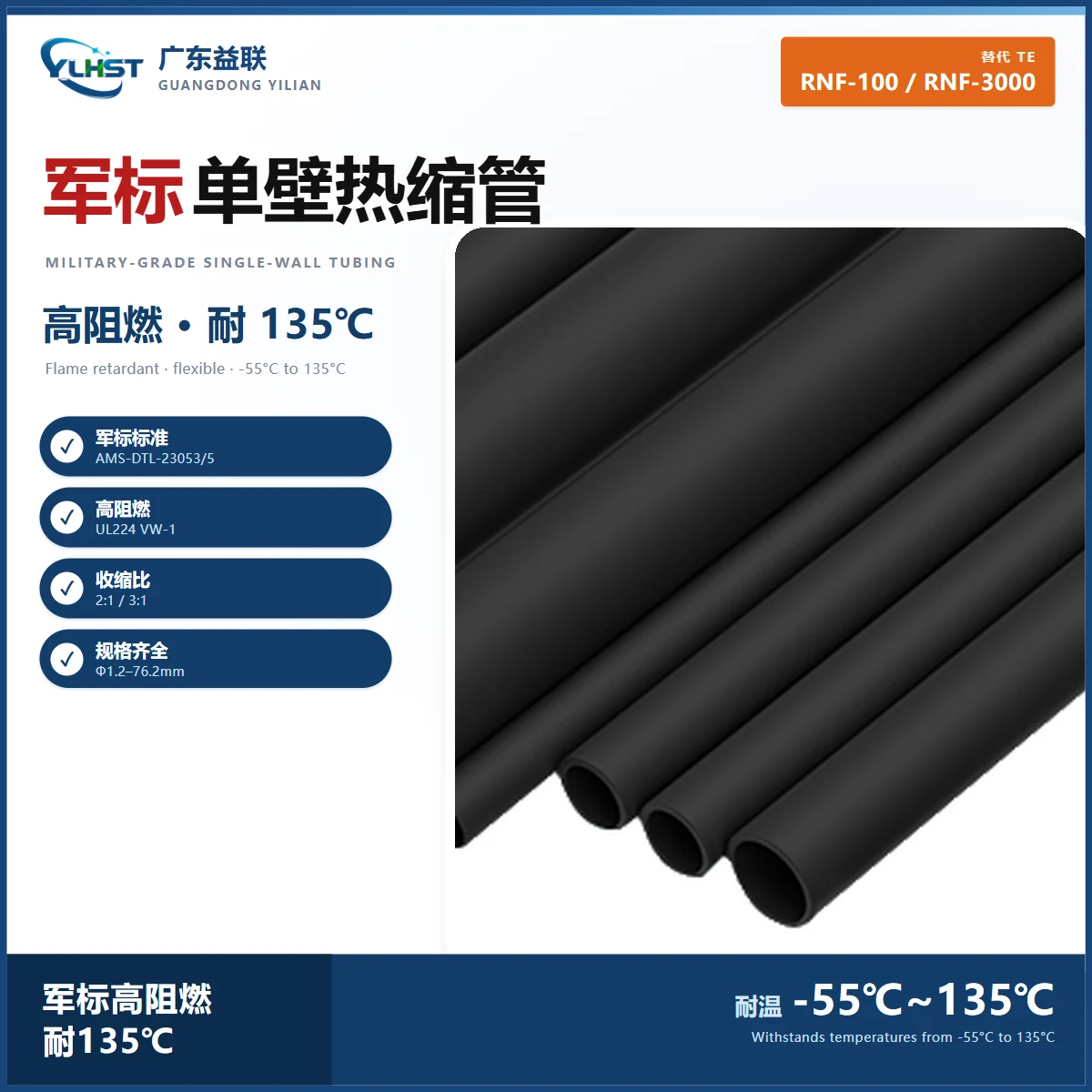
Start with the conclusion: heat-shrink tubing, heat-shrink sleeve and heat-shrinkable sleeve all describe the same product — a polyolefin insulating sleeve that contracts radially when heated. There is no technical difference; they are colloquial and formal names for one item.
"Tubing" is the shortest everyday term. "Sleeve" emphasises that it is slid over a cable. "Heat-shrinkable" follows the materials terminology. Specification sheets, drawings and purchase orders mix them freely, and all refer to sleeving that meets standards such as GJB 7270-2011 or UL 224.
There is no hidden industry convention where "tubing" means single wall and "sleeve" means dual wall. Manufacturers, distributors and end users have never agreed on such a split, and the same supplier may use both words on one quotation for product from the same line. The words that actually distinguish single from dual wall are "single wall", "dual wall", "adhesive-lined" and "with adhesive" — not the suffix.
The terms that do change the product
The real risk is between products that sound alike but work differently.
| Term | Construction | How it differs from heat-shrink tubing |
|---|---|---|
| Heat-shrink film | Thin sheet that shrinks when heated | Sheet, not tube; used for packaging, not cable insulation |
| Cold-shrink tube | Pre-expanded elastomer held by a support core | No heat; the core is pulled out and the tube contracts by itself, used on outdoor cable |
| Silicone tube | Straight silicone rubber tube | Does not shrink; relies on an interference fit, high temperature but no sealing grip |
| PVC sleeve | Straight extruded PVC tube | Does not shrink; the wire is threaded and fixed, insulates but not at high temperature |
| Braided sleeving | Woven nylon or polyester | Does not shrink; provides abrasion resistance and bundling, no insulation or seal |
A short memory aid: if it must be heated to grip, seal and insulate, it is heat-shrink tubing. If it is slid on without heat, it is probably a silicone or PVC sleeve. If a core is pulled out and it contracts by itself, it is cold shrink.
English terminology
For export purchasing or reading English datasheets, the two usual terms are heat shrink tubing and heat shrinkable sleeve, and they are equally interchangeable in English. Adhesive-lined versions are written dual wall heat shrink tubing with adhesive; single-wall versions as single wall heat shrink tubing. All of them point to the same heat-shrinkable insulating sleeve.
How to avoid buying the wrong part
The name is not the risk; an incomplete specification is. In practice:
Describe parameters rather than names — temperature class (125 °C), shrink ratio (2:1), inside diameter and colour.
State whether adhesive is required. If water sealing matters, specify dual wall, adhesive-lined; otherwise single wall insulation is the default.
Give the outside diameter of the item to be covered, and let the supplier recommend a size that will grip after recovery.
Ask for the specification approval sheet and a sample. Work to the approval sheet, and run a shrink test when needed.
With the parameters clear, it does not matter whether the other party says tubing or sleeve. YLHST supplies samples and approval sheets for common sizes such as K125 single wall.
Film, tape and sheet are different again
Some buyers also confuse tubing with heat-shrink film and heat-shrink tape. Film is a sheet material used to wrap large-diameter cable or irregular shapes; tape is a wrapping material used for repair and corrosion protection. Both rely on heat to shrink, but their form and installation differ, and neither substitutes for a tubular product. If the drawing says sleeve, quote a tubular product; if film or tape is genuinely required, state it separately in the technical requirement.