
The connector backshell is one of the highest-failure-rate locations in any harness. Broken conductors, water ingress, intermittent contacts and insulation breakdown look like unrelated faults; most of them come back to the same two causes. The stress at the connector root was never relieved, and the gap at the backshell was never sealed.
Four failure modes at the backshell
The first is a conductor broken by concentrated stress. The cable flexes repeatedly at the connector root, stress peaks at the bend point, and copper strands fatigue through.
The second is moisture ingress. A gap exists between the cable jacket and the connector tail; moisture follows the gap inward and insulation resistance falls, sometimes to a short.
The third is vibration wear. The cable moves while the equipment runs, the jacket edge rubs against the metal backshell, and the insulation is worn through.
The fourth is chemical attack. Salt spray, oil film and chemical vapour attack exposed conductors and braid. In practice the four occur together, which is why tape or a plain heat-shrink sleeve rarely fixes the problem.
How strain relief works
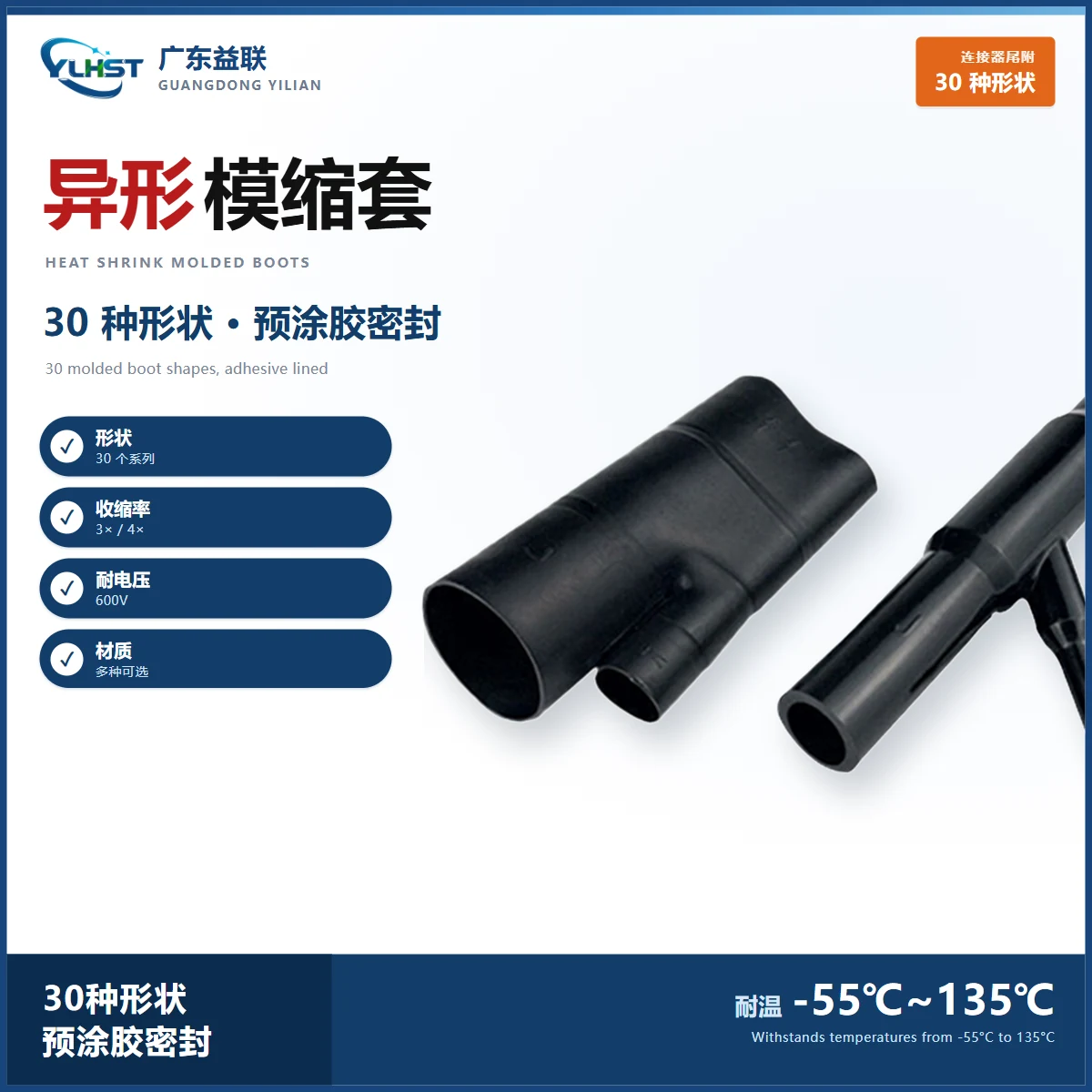
Strain relief is fundamentally about spreading a bend concentrated at one point across a length. A molded boot transitions from a large opening to a small one with wall thickness and hardness that change progressively, so after recovery it forms a tapered cone. When the cable bends, the deformation is distributed along that cone rather than concentrated at the connector root. At the same time the boot is bonded to the cable jacket and the backshell by hot-melt adhesive, so the load is carried by the assembly as a whole, and resistance to flexing and pulling rises accordingly.
How the adhesive seal works
Molded boots are supplied with a pre-coated hot-melt adhesive on the inner wall. During recovery the adhesive melts and flows outward, filling every gap between cable jacket, connector tail and boot, and forms a continuous seal when it cools. The adhesive grade sets the ceiling on that seal: soft low-temperature adhesives suit ordinary environments, high-strength high-temperature adhesives suit harsh ones.
| Adhesive code | Temperature range | Performance | Material grades |
|---|---|---|---|
| /42 | −40 to 60 °C | General purpose, bonds well to PVC and metal | −4, −71 |
| /86 | −55 to 120 °C | High strength, good fluid resistance | −4, −71, −25, −100 |
| /225 | −75 to 150 °C | High strength, good fluid resistance | −25 |
| /180 | −80 to 80 °C | Good water sealing, flexible at low temperature | −100 |
Material sets the ceiling
Sealing keeps water out; material decides what the part survives. The −12 modified fluororubber grade works from −55 °C to 200 °C and resists oil and solvents, which suits aviation and engine-bay duty. The −25 fluid-resistant rubber is harder, with strong chemical resistance and abrasion performance, for chemical and metallurgical environments. Choose the wrong material and the best seal will still fail at temperature or in the medium.
Matching the countermeasure to the failure
Field cases map cleanly onto the four modes. Water inside an outdoor sensor connector is usually a jacket-to-connector gap — moisture ingress. A charging cable broken at the strain relief on a handheld device is concentrated stress. Insulation cracking in an engine bay usually combines heat and oil, which makes it a material failure. Match accordingly: gaps to adhesive sealing, flexing to the tapered cone, heat and oil to the −12 fluororubber grade.
How to verify the protection
Verification is a matter of data. YLHST molded boots are tested to recognised methods: salt spray to GJB 150.11A-2009, with a 5 % salt solution at 35 °C for 48 hours of continuous spray and no corrosion on inspection; copper corrosion to UL 224 at 150 ± 5 °C for 168 hours; damp heat and mould to GJB 150.9A-2009 and GJB 150.10A-2009. Ask for those records and compare them with the actual duty before calling a backshell protected.