
A vehicle harness runs through the engine bay, the underbody, the doors, the cabin and the luggage area, under conditions far harsher than consumer electronics. A passenger car carries hundreds of branches and thousands of connections, and any breach of insulation, loss of sealing or lost marker can interrupt a signal, short a circuit or start a fire. Heat-shrink tubing is the basic consumable for insulation, sealing, mechanical protection and identification, so selection feeds directly into electrical reliability and warranty failure rates.
Three harsh environments in one vehicle
Different zones differ enormously in temperature, medium and mechanical load. Using one tube everywhere is usually the root cause of early failure.
The first is heat in the engine bay. Around the exhaust manifold of a modern turbocharged or direct-injection engine, local temperature can exceed 150 °C, and nearby harnesses sit in long-term radiant heat of 125–150 °C or more. A standard 125 °C polyolefin tube ages faster, embrittles and splits. The second is mud, water and oil film around the underbody and wheel arches. Road spray, de-icing salt and brake dust soak the underbody harness, and oil mist coats it; without a sealed joint, moisture reaches the terminals and contact resistance climbs. The third is vibration and abrasion everywhere. Engine vibration and road input keep the harness rubbing against body panels and adjacent parts, so the wall needs thickness and abrasion resistance, and a sleeve that works loose at the end will wear through the wire insulation.
Door hinges and the bonnet area also see repeated flexing, while the cabin is milder but asks for low smoke, halogen-free flame retardance and low odour. Automotive selection is therefore a matter of matching material and construction to zone, duty and medium.
Sealing: adhesive-lined dual wall is the mainstay at joints
The core of water protection is not insulation alone but a continuous seal between the sleeve, the wire and the terminal. A single-wall tube shrinks over the insulation and still leaves an annular gap at the end, along which moisture creeps. Real sealing needs an adhesive-lined dual-wall tube: an irradiation cross-linked polyolefin outer wall for insulation and mechanical protection, and a pre-coated hot-melt adhesive on the inside that melts and flows during recovery, filling the irregular gap between wall, wire and terminal and forming an elastic seal when it cools.
The common choices in automotive work are DWL-1 and DWL-2 dual-wall tubing, with 3:1 and even 4:1 ratios, which cover crimped terminals and joints whose outside diameter changes sharply. End sealing is the critical part: the sleeve must span the crimp with margin at both ends, and after recovery the adhesive should form a smooth fillet at each end. That fillet is the visible witness that the joint is actually closed. For door pass-throughs and underbody joints that see direct water, use a medium or heavy wall to compensate for abrasion from spray.
Adhesive-lined tubing typically reaches full recovery around 110 °C. Heat evenly with a hot-air gun so the adhesive melts through; shrinking only the outside while the adhesive stays solid produces a false seal.
Oil: engine bay and fuel system
Engine oil, gear oil, fuel vapour and coolant additives are everywhere in the bay. Ordinary polyolefin swells, softens and loses mechanical strength with long oil contact, so harnesses near the sump, fuel lines and injectors should use an oil-resistant rubber grade such as YJDR150.
YJDR150 is based on oil-resistant rubber, rated to 150 °C continuous, with good tolerance of mineral oil, fuel and grease while staying soft and flexible — suited to an engine bay that is both hot and oily. Harnesses near the fuel system also need resistance to fuel swelling and oil-mist ageing; ask the supplier for volume change and tensile retention after oil immersion, and run the immersion-plus-insulation test required by the OEM specification. A standard dual-wall tube seals well but is not designed for long mineral-oil immersion, so it is not a straight substitute.
Heat: choose upward from the measured temperature
The rule for temperature is to go up, not down: take the measured working temperature and add 20–30 °C of margin. Cabin and door harnesses generally need a 125 °C class such as K125. General engine-bay areas need 135 °C, which K135, DWL-1 and TM135 cover. Near the exhaust manifold and turbocharger, where radiant heat is intense, 175 °C and even 200 °C classes are required.
The 175 °C class is served by KT175 PVDF tubing, which also resists chemicals and oil and is low-smoke halogen-free. The 200 °C class calls for VT200 fluororubber (Viton) tubing — flexible, oil and solvent resistant, and a common choice for high-temperature harnesses around military and aero engines. Raising the class raises both material cost and shrink temperature, so the hot-air gun needs more power. High-temperature zones are usually oily as well, and VT200 and KT175 are themselves oil resistant, which is more compact and more reliable than sleeving an ordinary tube inside an oil-resistant one.
Marking: printable sleeves keep the circuit traceable
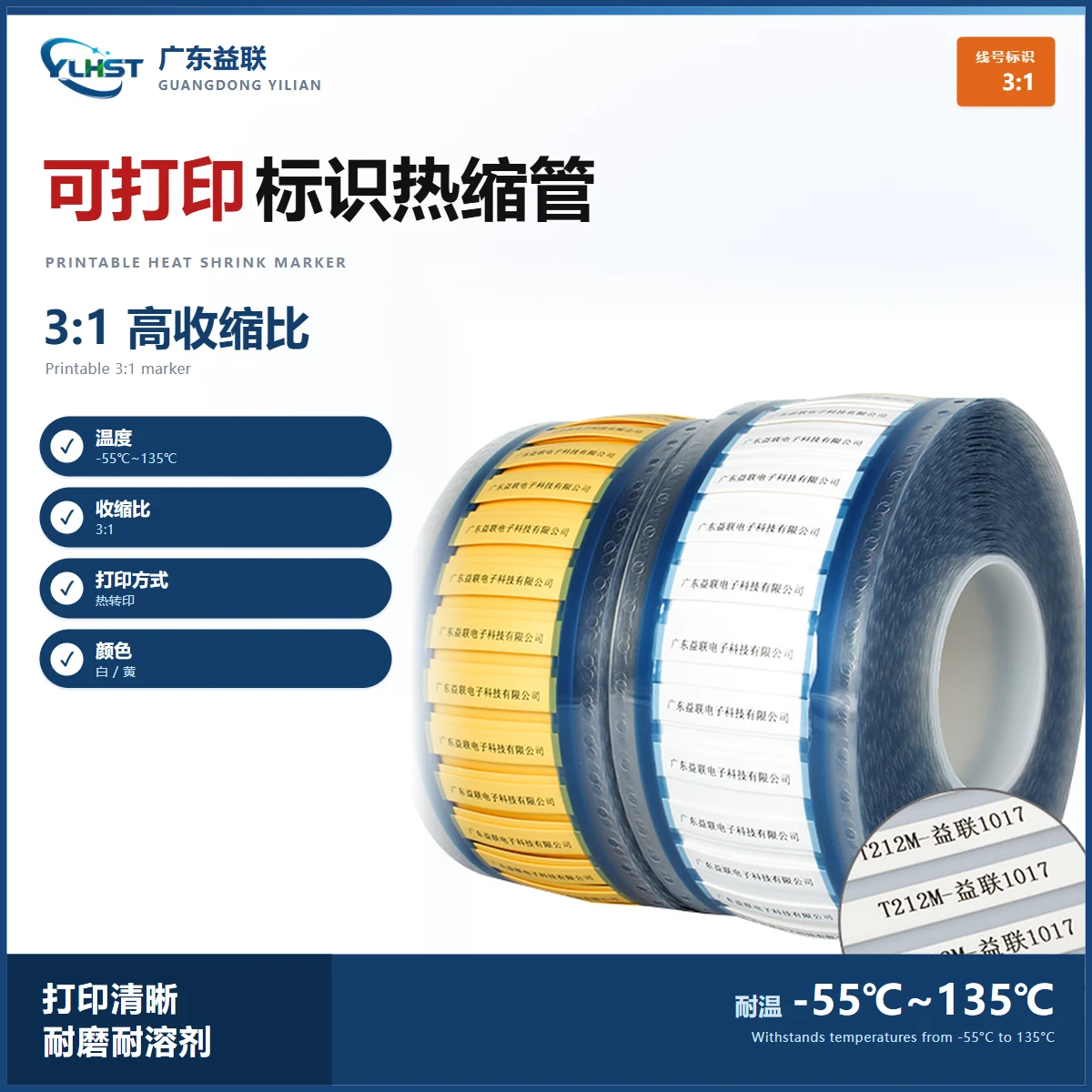
With hundreds of circuits, end-of-line testing and dealer service both depend on wire numbers. TM135 printable marker sleeve is made for this: print the wire number, terminal number or circuit number, slide it on and shrink it in place. The print resists abrasion and does not fade at 135 °C. Compared with printing directly on the wire, a marker sleeve carries more characters, sits tight against the conductor and cannot migrate — which is why it is standard harness practice at OEMs.
Selection table by harness location
| Location | Duty | Recommended material / part | Key requirement |
|---|---|---|---|
| Underbody and wheel-arch joints | Mud, de-icing salt, vibration | DWL-1 dual wall, 3:1 / 4:1 | End sealing and abrasion resistance |
| Door pass-through | Moisture, repeated flexing | DWL-1 / DWL-2 dual wall | Sealing plus flex resistance |
| General engine bay | 125–135 °C radiant heat | K135 single wall / DWL-1 dual wall | 135 °C class, VW-1 flame retardant |
| Sump and fuel system | Engine oil, fuel vapour | YJDR150 oil-resistant rubber | Oil and fuel resistance, 150 °C |
| Exhaust and turbo area | 175–200 °C radiant heat | VT200 fluororubber / KT175 PVDF | High temperature plus oil resistance |
| Cabin instrument harness | Ambient, low smoke halogen-free | K125 single wall | Insulation, flame retardance, colour range |
| Whole-vehicle circuit marking | Wire-number management | TM135 printable marker | Printable, abrasion-proof, non-fading |
Automotive standards and documentation
Automotive component suppliers generally work to IATF 16949:2016, the automotive quality management system built on ISO 9001 that emphasises defect prevention and supply-chain management, and uses APQP, FMEA, MSA, SPC and PPAP for advanced quality planning and part approval. Heat-shrink tubing is a line item in the harness BOM; when it enters a PPAP submission the supplier normally provides material certification, RoHS and REACH compliance, dimensional and performance test reports, and carries out temperature cycling, oil, water and abrasion validation to OEM standards such as Volkswagen LV 214.
On environmental compliance, export and joint-venture programmes generally require RoHS 2011/65/EU and REACH (EC) No 1907/2006, restricting lead, mercury, hexavalent chromium and similar substances. YLHST supplies heat-shrink tubing to harness makers under ISO 9001 and a military quality system, meets RoHS and REACH requirements, and can support an OEM PPAP package.