
The difference between an electric vehicle and a combustion car is not only the drivetrain. The harness changes character: a high-voltage system carrying hundreds of volts and hundreds of amps now sits alongside the low-voltage signal network. A seal failure or insulation breach on a 400–800 V bus is a far more serious event than on a 12 V circuit, which is why adhesive-lined dual-wall tubing became the default at HV joints and branches.
Why EV harnesses are harder to protect
Four conditions separate EV harnesses from conventional low-voltage looms. Voltage and current are high: drive bus voltages of 400–800 V with peak currents of hundreds of amps raise dielectric and temperature-rise requirements well above 12 V or 24 V systems. Water exposure is severe: charge ports, underbody runs and pack entries face rain, pressure washing and wading, with IP67 expected across the vehicle and IP6K9K at the underbody and wheel areas. Temperature swings are wide: the pack and motor area runs hot, while cold starts demand flexibility without cracking, typically −40 °C to 125 °C or wider. Vibration is continuous, and branch roots and connector tails concentrate the stress.
Single-wall tubing solves the insulation half of the problem. It does not solve the water half: after recovery, micro-gaps remain between tube, conductor and connector shell, and moisture follows them into the joint. That is the failure mode adhesive-lined tubing exists to close.
How an adhesive-lined tube seals
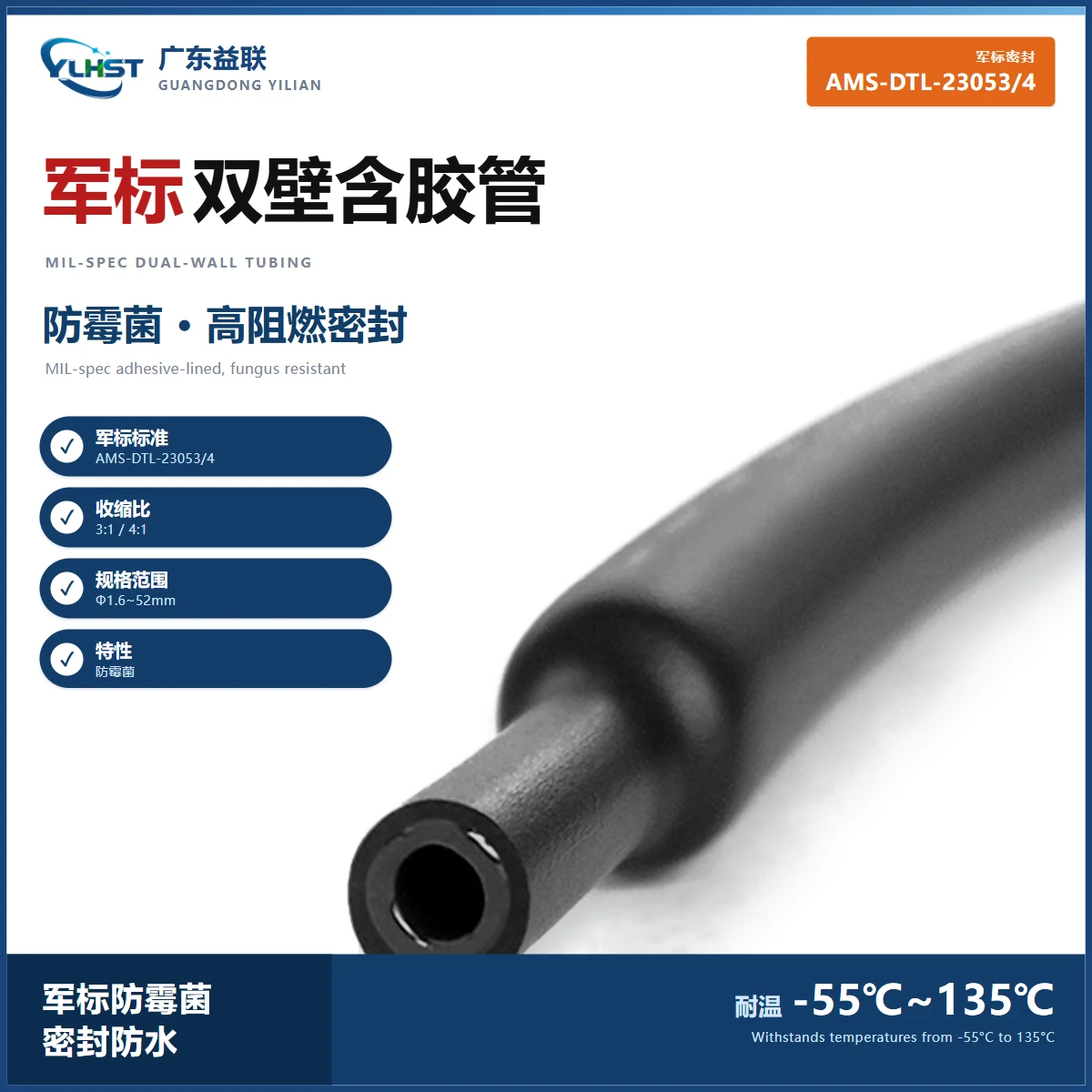
DWL-1 is a military-grade adhesive-lined dual-wall polyolefin: an irradiation cross-linked modified flame-retardant polyolefin outer wall for insulation, flame resistance and mechanical protection, with a hot-melt adhesive inner wall. During shrinking, the outer wall recovers while the adhesive melts and fills every gap between tube, cable and connector shell, then solidifies into a continuous seal.
The construction is available in 3:1 and 4:1, starts shrinking at about 80 °C, is fully recovered at about 110 °C, operates from −55 °C to 135 °C, withstands 2500 V for 60 s without breakdown, meets VW-1 (self-extinguishing within 60 s) and is tested to GJB 7270-2011. The high ratio is what allows one part to cover a step or a branch where the diameter changes sharply.
Four places it is used
| Location | Conditions | Recommended | Reason |
|---|---|---|---|
| HV connector tail | High voltage, vibration, IP67/IP6K9K | DWL-1 4:1 | Adhesive seal plus high ratio over the step; 2500 V dielectric |
| Pack harness branch | T/Y branch, sharp diameter change | DWL-1 4:1 | One part covers multiple legs, adhesive fills the root |
| Charge port harness | Rain, pressure washing, outdoor exposure | DWL-1 3:1 / 4:1 | Hot-melt seal supports the vehicle IP6K9K target |
| Motor controller harness | Heat, oil mist, vibration | DWL-1 | 135 °C, VW-1, resistance to normal oils |
Process details that decide the seal
The part contributes about seventy percent of the result; the process contributes the rest.
- Temperature: use an adjustable hot-air gun and hold the tube wall at 110–140 °C so the adhesive fully melts. Too hot and the outer wall recovers unevenly while adhesive is pushed out.
- Direction: heat from the middle toward both ends, or steadily from one end, so air and excess adhesive escape at the open end instead of being trapped.
- Adhesive witness: a properly sealed joint shows a thin, continuous bead of adhesive at both ends. No bead means the adhesive did not melt or the tube was oversized.
- Sizing: expanded ID slightly larger than the maximum OD, recovered ID clamping the bundle, with at least 20 % compression after recovery.
Compared with alternatives
The common alternatives are single-wall tubing plus electrical tape, or a potted splice. Single-wall tubing insulates but does not seal, and tape loosens and ages under vibration and thermal cycling. Potting seals reliably but adds volume, cost and maintenance difficulty. Adhesive-lined tubing sits between them: a bonded seal in a low-profile part that can be installed on the line and inspected visually.