
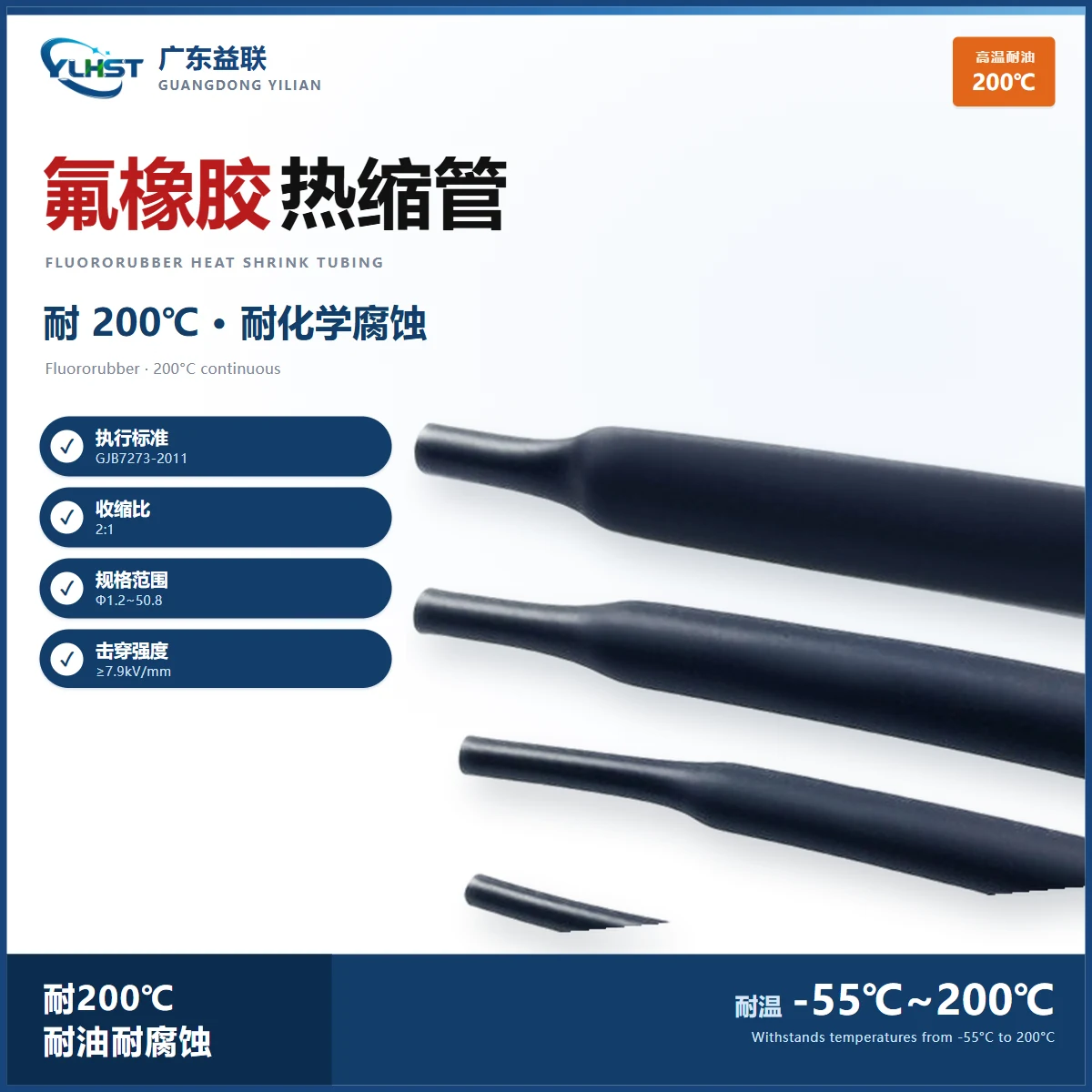
YJVT200 is a flexible fluororubber heat-shrink tubing rated −55 °C to 200 °C. These are the seven questions that recur in selection reviews, process trials and purchasing discussions, answered as briefly as the subject allows.
Q1: YJVT200 or YJDR150?
YJDR150 is oil-resistant rubber rated −55 °C to 150 °C. It is cost-effective and suits ordinary equipment and normal oil exposure. YJVT200 covers −55 °C to 200 °C and is intended for continuous temperatures above 150 °C, aggressive aviation fuels, chemical solvents and nuclear-industry conditions. The quick rule: above 150 °C sustained, or strong oil and solvent contact, choose YJVT200; within 150 °C with normal oil, YJDR150 is enough.
Q2: Can a normal hot-air gun process it?
Yes, provided the gun has adjustable temperature. YJVT200 is fully recovered at 200 °C, so set the nozzle high enough that the tube wall itself reaches that temperature; 250–300 °C at the nozzle is the usual starting point. Never use an open flame or a lighter, and never hold the gun stationary on one spot. In cold workshops, pre-warm the assembly before the final shrink. An oven gives the most even result and the most stable properties.
Q3: What does the thin-wall TW version trade away?
Formulation, temperature rating, standard and shrink temperature are identical; only the wall is thinner. The advantage is a smaller added diameter, which suits dense wiring inside equipment and tight assembly gaps. The trade-off is reduced abrasion, crush and impact resistance, so TW is not the right choice for exposed external runs. Use the standard wall where mechanical contact is possible.
Q4: Can it replace TE Raychem RW-200 directly?
The product is aligned with AMS-DTL-23053/13 and benchmarked against RW-200, which provides the technical basis for a domestic replacement. A project should still not substitute unconditionally: run the full environmental programme on prototypes — thermal cycling, heat shock, fluid immersion, vibration — and move to volume only after the project's own tests pass.
Q5: What is the service life under radiation?
Fluororubber tolerates radiation better than ordinary polymers, but life depends on total dose, temperature and simultaneous fluid exposure, so there is no single figure. Low-dose environments can use the part directly; for high-dose conditions, provide the project's total dose and run a targeted radiation-ageing evaluation.
Q6: Why does the tube wrinkle or fail to grip?
Three causes dominate: insufficient heating, so the tube never reaches full recovery; an oversized part; or movement of the harness before the tube has cooled. Check in that order — temperature, size, then handling during cooling.
Q7: Does YJVT200 seal against water?
No. YJVT200 is a single-wall, unlined fluororubber tube. It grips mechanically and provides dust protection, but with no hot-melt adhesive it cannot form a pressure-tight seal. Where a joint must be waterproof, design it together with an adhesive-lined dual-wall tube.
A five-point checklist
- Confirm the continuous harness temperature: above 150 °C is the trigger for YJVT200.
- Confirm the environment: aviation fuel, hydraulic oil, chemical solvents, low-dose radiation.
- Confirm the location: exposed and impact-prone means standard wall; tight internal space means TW.
- Confirm the process: can the heat source hold the tube wall above 200 °C reliably?
- Confirm the sealing requirement: a single-wall tube cannot do it alone.