
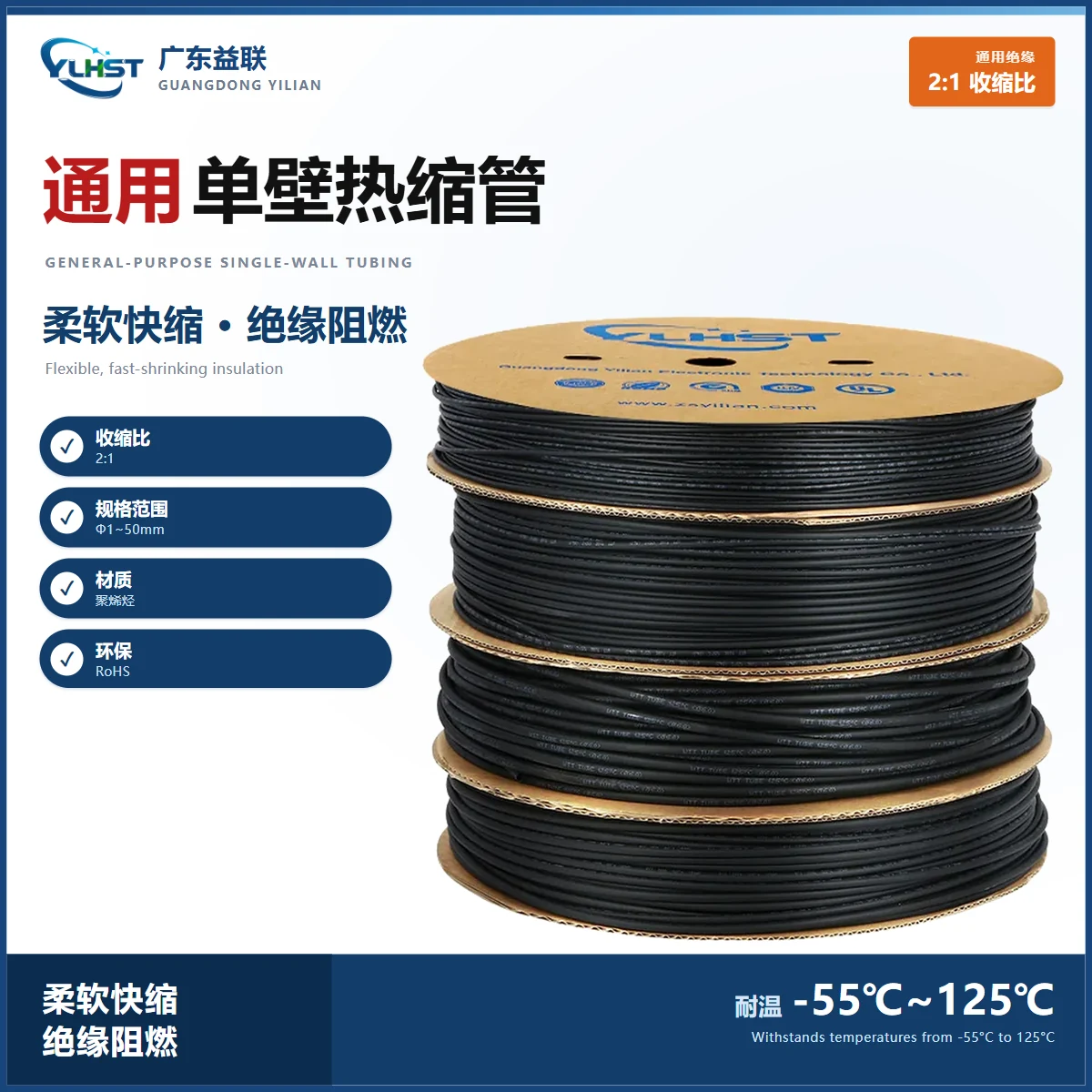
Every harness joint that needs insulation carries a short length of heat-shrink tubing. It looks like a piece of plastic pipe, but heat it and it closes onto the cable like it remembers the smaller size it used to be. Buyers and process engineers new to harness work often ask the same questions: why does it shrink, what does it protect against, and why are there so many types? This note answers those from the material up.
How a tube remembers its shape
Heat-shrink tubing is a specially formulated polyolefin. During production the tube is heated into a rubbery state, expanded to a larger diameter and cooled while held in that shape. When you later heat it with a hot-air gun, the polymer chains relax and the tube recovers toward its original, smaller diameter, closing onto whatever it covers.
The key process is irradiation cross-linking. Polyolefin starts as linear molecular chains that melt and flow when heated. Electron-beam irradiation forms C—C covalent bonds between chains, creating a three-dimensional network. The material becomes thermoset: it no longer flows at high temperature, it springs back instead. That network is what gives the tube its reliable memory, heat resistance and dielectric strength. A standard single-wall tube starts to shrink at about 84 °C and is fully recovered at about 110 °C.
Five jobs in one tube
A single length of tubing usually covers more than one requirement at once:
Insulation. Once recovered, the tube wraps exposed conductors and joints and provides electrical insulation, preventing shorts and accidental contact. Standard single-wall tubing is typically rated for 600 V.
Waterproof sealing. Adhesive-lined (dual-wall) tubing has a hot-melt adhesive on the inner wall. When heated, the adhesive melts at the same time the outer wall recovers, filling the gap and forming a continuous seal around a splice or connector.
Mechanical protection. The recovered wall holds a bundle together, resists abrasion and protects the joint from pulling, rubbing and impact.
Identification. Colours mark phases and circuits; printable marker sleeves carry wire numbers for assembly and maintenance.
Strain relief. At solder joints and connector roots the tube spreads bending stress and reduces the risk of fatigue failure in repeatedly flexed harnesses.
The material families
Almost all tubing shares the same cross-linked structure, but the base polymer sets the temperature and chemical limits:
- Polyolefin, 125 °C: the workhorse for general insulation, bundling and terminal covering.
- Modified polyolefin, 135 °C: automotive, industrial control and military harnesses that need more thermal margin.
- Adhesive-lined polyolefin: 3:1 and 4:1 dual-wall constructions for splices, connectors and outdoor joints where moisture ingress is the real risk.
- Oil-resistant rubber, 150 °C: engine bays and fuel systems where oil, diesel and hydraulic fluid attack standard polyolefin.
- PVDF, 175 °C: chemical resistance plus a transparent option for inspection windows.
- Fluororubber and FEP, 200 °C: tight bends next to hot components, aerospace and defence harnesses.
- PTFE, 260 °C: the extreme end, for strong chemicals and very high temperature.
How it is installed
Cut the length with enough margin: tubing also shrinks 5–10 % lengthwise, so a joint that is measured exactly will end up short. Slide the tube on before terminating the wire, position it over the joint, and heat evenly from the middle outwards with a hot-air gun at 300–350 °C until the wall is smooth and the adhesive, if present, has flowed at both ends. Avoid a direct flame: it scorches the surface and hides under-recovery.
What to confirm before ordering
Four numbers decide the part: the expanded inner diameter must clear the largest feature of the joint, the recovered inner diameter must grip the smallest, the continuous temperature must cover the hottest sustained condition with margin, and the material must survive whatever the harness touches. Flame rating (VW-1 for vertical burn), RoHS 2011/65/EU and REACH declarations are normally part of the datasheet package.
YLHST has manufactured heat-shrink tubing since 2014 at a 15,000 m² plant in Zhongshan, Guangdong. The range covers −55 °C to 260 °C in 13 product families, produced to the GJB7274-2011 military standard, with ISO 9001:2015 and IATF 16949 quality systems. If you are choosing between constructions, send the cable diameter and the operating conditions and our engineers will narrow it down.