
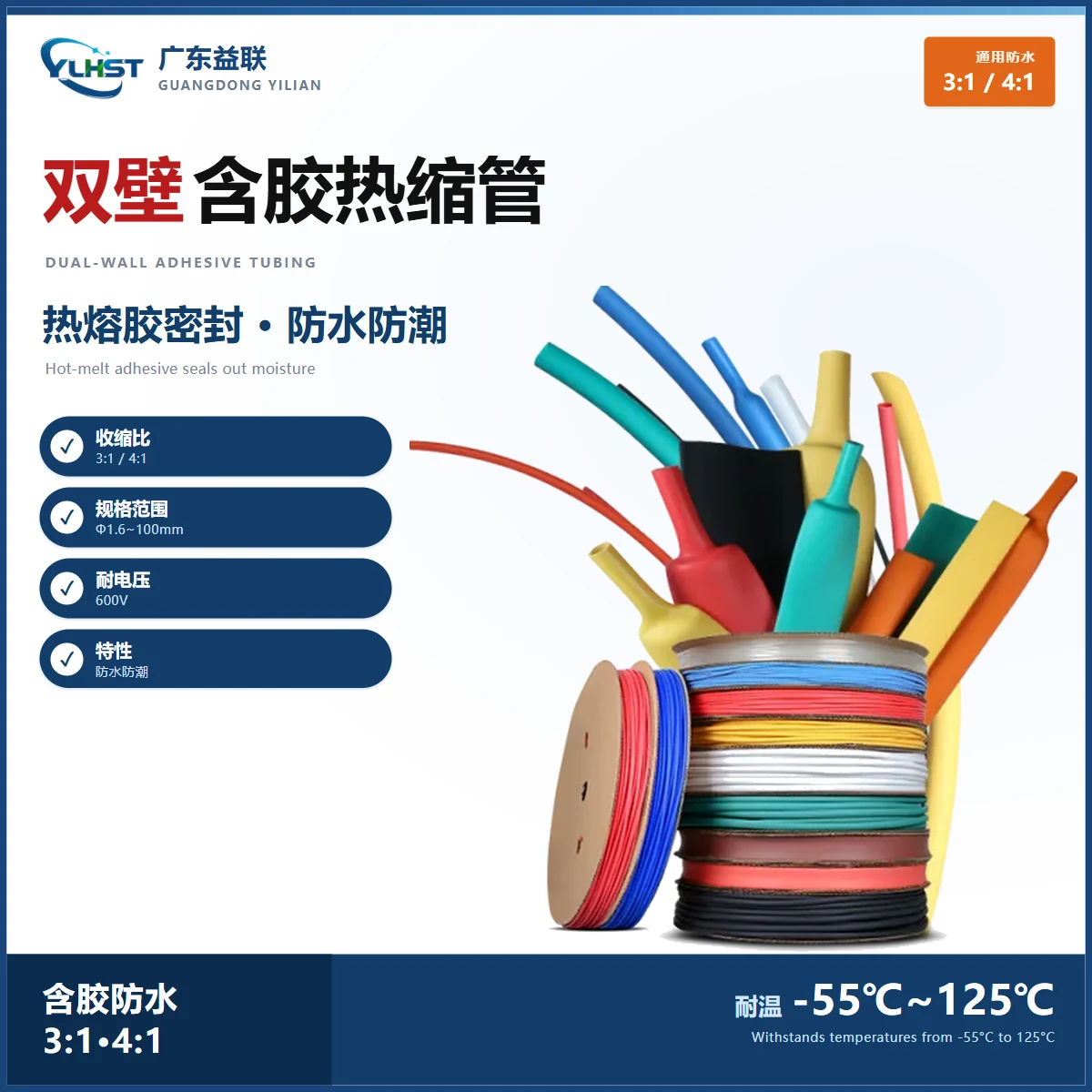
The most common selection question is not about temperature or size: it is single wall or dual wall. One camp says single wall is cheaper and sufficient; the other insists on adhesive-lined tubing for everything. The real answer depends on whether the joint has to keep water out.
Structure: one layer or two
Single-wall tubing is a single layer of irradiation cross-linked polyolefin. It insulates and grips through the recovered wall alone. Dual-wall tubing is co-extruded: an outer layer of cross-linked polyolefin for insulation, flame resistance and mechanical strength, with a hot-melt adhesive on the inner surface. When heated, the outer wall recovers while the adhesive melts and fills the gap between tubing and cable.
That adhesive layer is the whole difference. A single-wall tube sits against the cable but leaves micro-channels along the surface; an adhesive-lined tube bonds to the cable and to itself, producing a continuous barrier.
Performance and cost
| Item | Single wall | Dual wall |
|---|---|---|
| Structure | One polyolefin layer | Polyolefin outer, hot-melt adhesive inner |
| Water sealing | Limited, not moisture proof | Excellent, adhesive seal |
| Mechanical strength | Moderate | Higher, adhesive fills and grips |
| Shrink ratio | Usually 2:1 | Usually 3:1 or 4:1 |
| Cost | Low | Higher |
| Typical parts | K125 | DWL-1 / DWL-2 |
Single-wall tubing is simpler to make and uses standard compound, so it is cheaper and usually in stock. Dual-wall tubing needs co-extrusion and an adhesive layer, and typically costs 1.5 to 2 times the single-wall price at the same size. Where sealing is genuinely required, that premium often replaces a separate potting or dispensing step, so the total cost of the joint can be lower.
Where each one belongs
Single wall suits dry, indoor insulation: panel wiring, colour coding, terminal covering and cost-sensitive volume work. Dual wall suits moisture, outdoors, buried joints and any splice that must stay dry: automotive harness joints, outdoor telecom equipment, cable branches, and military assemblies tested for salt fog and damp heat.
A frequent question is whether wrapping a single-wall joint with sealing tape is an acceptable substitute. It works as a short-term repair, but tape relies on overlap and adhesion; the seam remains a path for moisture, and the adhesive ages and lifts. An adhesive-lined tube forms a bonded seal that outlasts tape by a wide margin, which is why the GJB 150 salt-fog and damp-heat series expose the difference so clearly.
Representative products
K125 is the standard single-wall part: irradiation cross-linked polyolefin, 2:1, −55 °C to 125 °C, VW-1 flame retardant, full colour range. DWL-1 is the military-grade adhesive-lined dual wall: flame-retardant polyolefin outer, hot-melt adhesive inner, 3:1 and 4:1, −55 °C to 135 °C, 2500 V/60 s without breakdown, produced to GJB 7270-2011 and GB/T 7113.2 and tested to the GJB 150 environmental series.
Decision path
Ask two questions first: does the joint have to be waterproof, and is it outdoors or in a wet area? If either answer is yes, specify adhesive-lined dual wall. If both are no, ask whether the diameter changes sharply or the joint has a step. A large step points to 3:1 or 4:1 dual wall for coverage; a small one is fine with 2:1 single wall. Then choose the polymer from temperature and oil exposure.
In one sentence: single wall insulates, dual wall seals. Dry, indoor, cost-sensitive work belongs to K125; wet, outdoor and sealed splices belong to DWL-1 and its variants.