
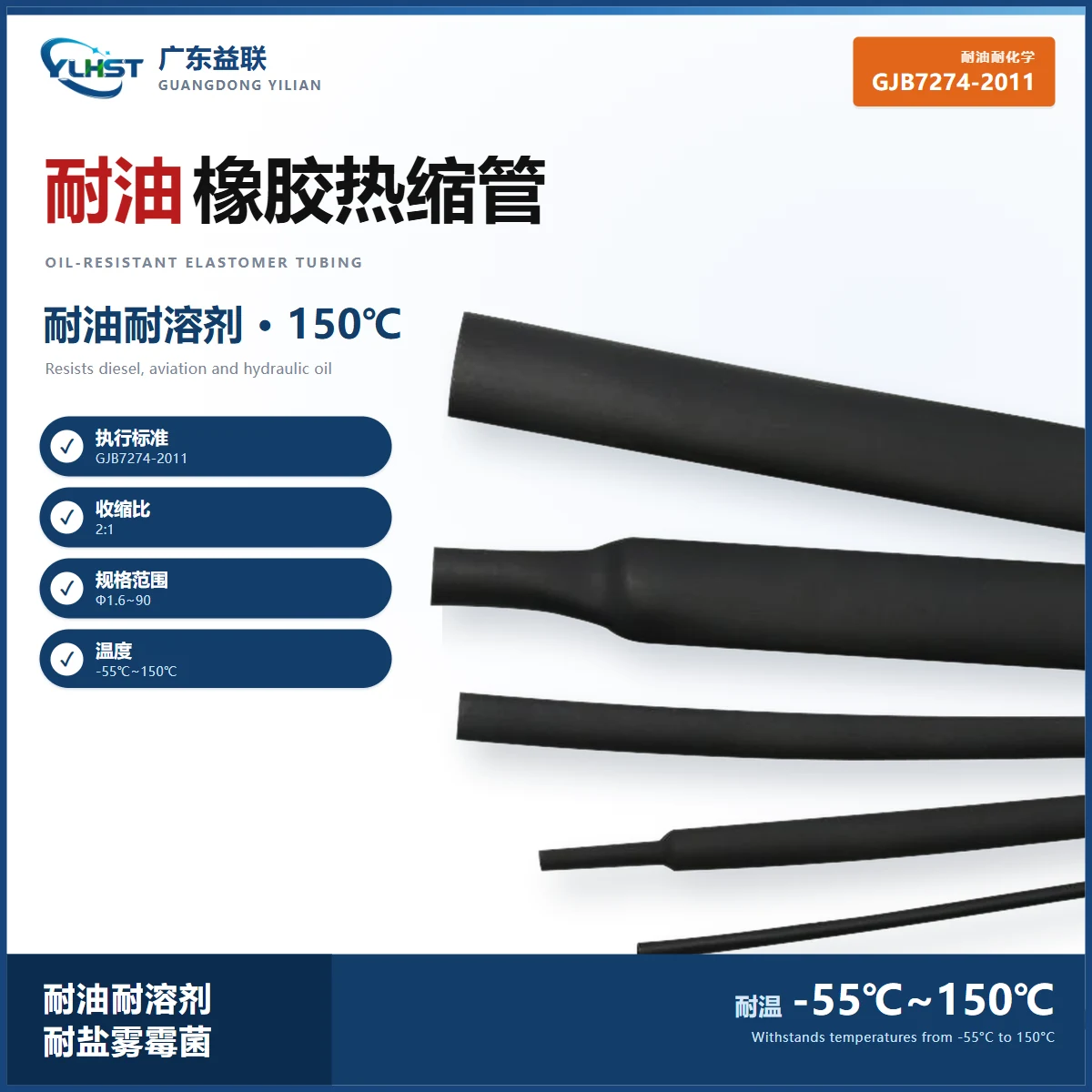
"Not the most expensive tube, the right one" applies with unusual force to oil-resistant selection. In the same vehicle, the engine bay, the hydraulic system and a machine-tool drag chain place completely different demands on a sleeve. Taking YJDR150 oil-resistant rubber tubing as the worked example, selection comes down to three questions: environment, temperature, size.
Step one: read the environment — is oil resistance actually needed?
Start with one question: does the harness meet mineral oil, hydraulic fluid, lubricating oil, cutting fluid or fuel for long periods? If yes, choose an oil-resistant grade. YJDR150 is built on an irradiation cross-linked modified polyester elastomer and oil-resistant rubber system. After fluid immersion testing at 23 ± 3 °C for 24 hours, tensile strength remains at least 10.4 MPa and elongation at break at least 200 %, with reliable resistance to oil, chemical attack and solvents.
If the environment barely touches oil, ordinary polyolefin tubing usually does the job, and there is no reason to pay for performance the application will not use.
Step two: read the temperature to fix the class
The temperature class decides whether the sleeve can work at the target temperature long-term. YJDR150 is rated −55 °C to 150 °C continuous, with a minimum shrink-start temperature of 125 °C and full recovery at 200 °C within 5 minutes. The test is simple: compare the highest sustained temperature around the harness with 150 °C. If it stays below 150 °C and the low end does not go below −55 °C, YJDR150 covers it. Above that, move to a higher class such as fluororubber tubing.
Step three: size and shrink ratio against the bundle
YJDR150 uses a 2:1 shrink ratio: the expanded inside diameter is about twice the fully recovered inside diameter. The rule is that the bundle's outside diameter must sit between the recovered inside diameter and the expanded inside diameter, with some margin — in practice the expanded diameter should be slightly larger than the bundle. Seventeen sizes run from Φ1.6 to Φ90, covering signal wires through heavy cable.
| Size | Expanded ID (mm) | Expanded wall (mm) | Recovered ID (mm) | Recovered wall (mm) |
|---|---|---|---|---|
| Φ1.6 | 2.0 ± 0.40 | 0.25 ± 0.08 | ≤ 0.85 | 0.50 ± 0.05 |
| Φ2.4 | 2.8 ± 0.40 | 0.27 ± 0.08 | ≤ 1.2 | 0.58 ± 0.05 |
| Φ3.2 | 3.8 ± 0.40 | 0.36 ± 0.08 | ≤ 1.6 | 0.76 ± 0.15 |
| Φ4.8 | 5.3 ± 0.40 | 0.40 ± 0.08 | ≤ 2.4 | 0.84 ± 0.15 |
| Φ6.4 | 6.9 ± 0.40 | 0.45 ± 0.10 | ≤ 3.2 | 0.89 ± 0.15 |
| Φ7.9 | 8.3 ± 0.40 | 0.48 ± 0.10 | ≤ 3.9 | 0.93 ± 0.15 |
| Φ9.5 | 10.2 ± 0.60 | 0.50 ± 0.10 | ≤ 4.8 | 1.02 ± 0.20 |
| Φ12.7 | 13.5 ± 0.60 | 0.60 ± 0.12 | ≤ 6.4 | 1.22 ± 0.20 |
| Φ15.9 | 16.5 ± 0.60 | 0.66 ± 0.15 | ≤ 7.9 | 1.32 ± 0.28 |
| Φ19.1 | 20.5 ± 0.60 | 0.69 ± 0.15 | ≤ 9.5 | 1.45 ± 0.28 |
| Φ25.4 | 26.0 ± 0.60 | 0.88 ± 0.15 | ≤ 12.7 | 1.78 ± 0.28 |
| Φ30.0 | 32.5 ± 1.00 | 1.05 ± 0.15 | ≤ 14.5 | 2.05 ± 0.50 |
| Φ31.8 | 32.8 ± 1.00 | 1.10 ± 0.15 | ≤ 15.9 | 2.20 ± 0.41 |
| Φ38.1 | 41.5 ± 1.00 | 1.18 ± 0.20 | ≤ 19.1 | 2.41 ± 0.41 |
| Φ50.8 | 52.0 ± 1.00 | 1.35 ± 0.20 | ≤ 25.4 | 2.79 ± 0.41 |
| Φ76 | 78.0 ± 1.50 | 1.35 ± 0.20 | ≤ 38.0 | 2.70 ± 0.50 |
| Φ90 | 92.0 ± 1.50 | 1.35 ± 0.20 | ≤ 45.0 | 2.70 ± 0.50 |
Worked example: how Φ6.4 is used
Take Φ6.4: expanded inside diameter 6.9 mm, recovered inside diameter ≤ 3.2 mm. A bundle whose outside diameter falls between 4 and 6 mm — a 4 mm² or 6 mm² cable with its jacket, for instance — fits Φ6.4. If the bundle is closer to 3 mm, Φ6.4 still recovers with margin and insulation remains sound. Above 6.9 mm, move up one size.
For volume purchasing, group orders by the measured outside-diameter distribution of the harness and merge nearby sizes to reduce the number of stock items. YJDR150 is supplied cut to length and in reels, with common sizes held in stock, which avoids the familiar problem of large sizes out of stock while small sizes pile up. Where a project has many different wire gauges, a single size chosen on the largest diameter will still insulate correctly, though a stepped selection is tidier and more compact.
Two common mistakes
The first is treating the temperature class as the shrink temperature. YJDR150 is rated 150 °C continuous, but it starts shrinking at 125 °C and needs 200 °C for full recovery; install with a 200–250 °C hot-air gun or an oven, not with the low-temperature habits used for ordinary polyolefin. The second is selecting by the wire gauge number alone. The real bundle outside diameter includes the jacket and any terminal step, so select against a measured diameter, and go up a size when in doubt.
In closing
Environment, temperature, size — three steps, and the choice is usually right. YJDR150 covers the oil-exposed case with a 2:1 ratio, a Φ1.6 to Φ90 range, military-standard inspection and an oil-resistant compound.