
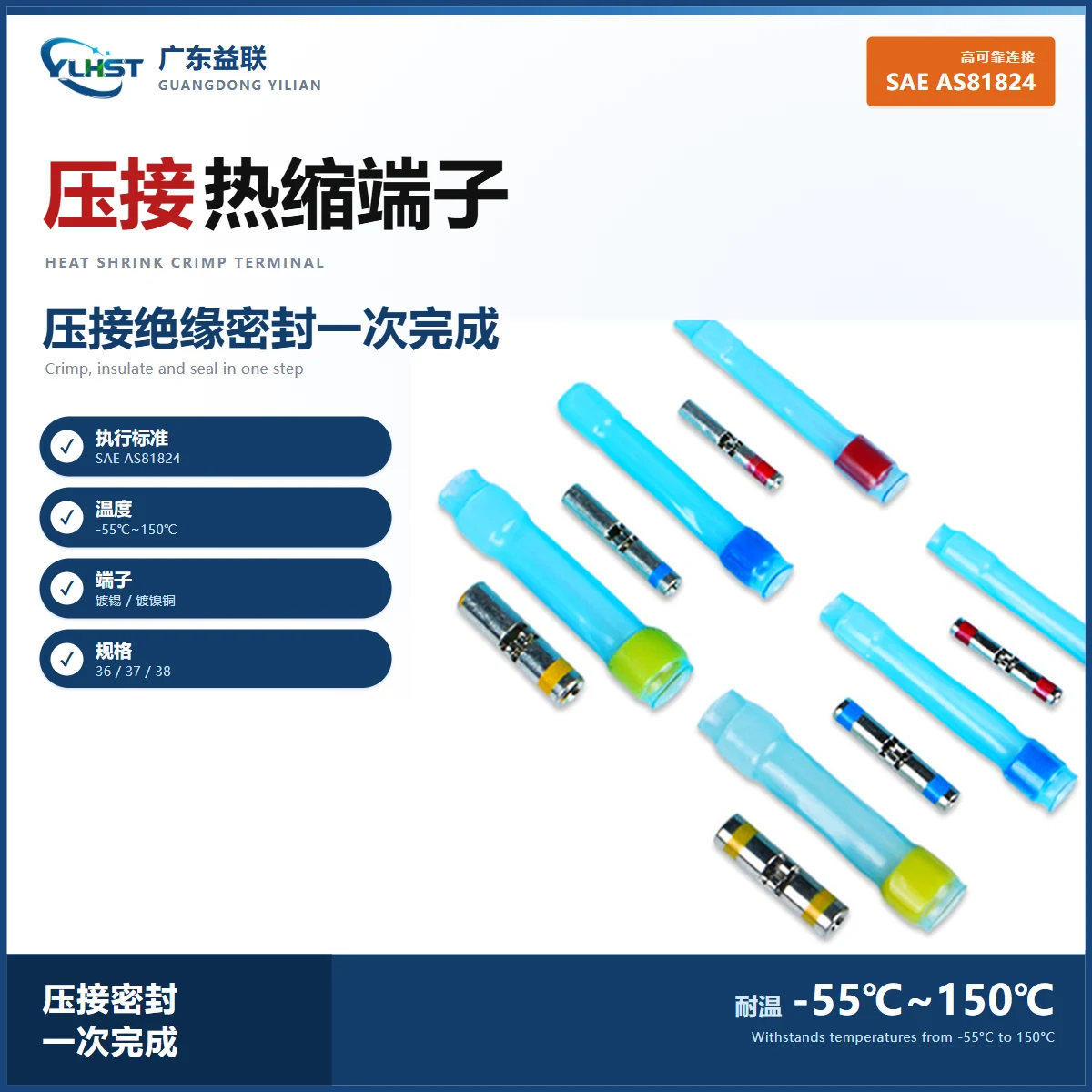
SAE AS81824 is the general specification for environment-resistant permanent crimp splices used in airborne electrical systems, and it is the basis for TE D-series and domestic YJD-series heat-shrink crimp terminals. The standard is split into a general specification and detail specifications that set temperature class, plating and construction for straight and Y-branch versions.
What it covers
The scope is copper crimp splices with a heat-shrink sleeve and hot-melt sealing adhesive, used for one-to-one and one-to-two splices in aircraft wiring. Bare crimp terminals and soldered joints are outside it. Two temperature classes dominate: 150 °C with tin plating and 200 °C with nickel plating. In hot zones, the nickel-plated class is the specification, not a preference.
Mandatory materials
- Crimp barrel: high-purity copper, tin or nickel plated. Nickel is required in high-temperature areas for creep and oxidation resistance.
- Sleeve: PVDF, flame retardant and resistant to aviation fluids and solvents.
- Adhesive: hot-melt adhesive that flows and wets the interface during shrinking. The three materials are qualified as a set, not individually.
Mandatory test programme
- Mechanical: splice tensile strength at least equal to the wire; the wire must break before the crimp pulls out.
- Electrical: stable contact resistance, with drift within limits after environmental cycling.
- Environmental: thermal shock, damp-heat ageing, random vibration, aviation fluid immersion and immersion sealing.
Assembly and marking rules
- Red, blue and yellow are wire-gauge identifiers only. The same colour means the same gauge; different suffixes are not interchangeable.
- Only the terminal-specific crimp tooling may be used, and the first article requires a crimp cross-section check.
- Shrinking must fully recover the sleeve and flow the adhesive without overheating and damaging the sleeve.
Qualifying a domestic equivalent
External similarity is not equivalence. The sequence is: material reports, room-temperature baseline tests, the full environmental programme, sample cross-section inspection, then a small-batch process validation. Each step answers a different question, and skipping the environmental block is the most expensive shortcut in the list.
Four misconceptions
- Identical appearance means compliance — materials and test values decide.
- Short-term heat resistance equals continuous rating — the rating is the continuous one.
- A good seal means a good splice — metal crimp strength comes first.
- Same colour means interchangeable — the full suffix defines the barrel construction.
AS81824 is a reliability system rather than a shape standard. Selection has to weigh temperature class, plating, tooling and environmental validation together. YJD-series splices are produced to this framework; request the qualification package with any sample order.