
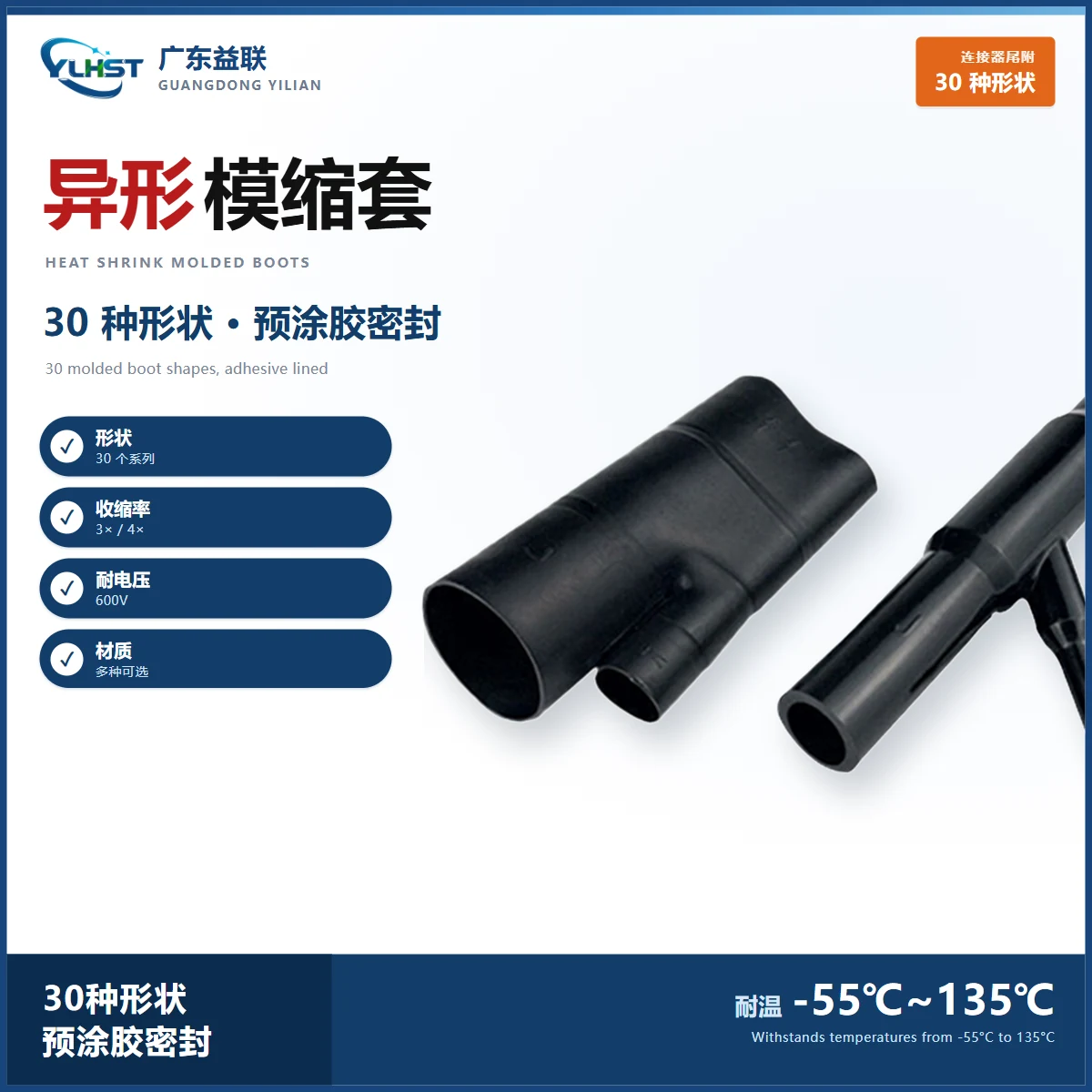
The first encounter with a molded boot part number usually produces confusion: MS-2A/I, MS-3B/T1, MS-4B/E. The code is not random. It is a sequence of opening count, series, shape, size and material. And the product itself is simpler than it looks: a pre-shaped heat-shrink cover that seals, insulates and relieves strain where a cable meets a connector.
What a molded boot does
The weakest point of a cable is rarely the middle. It is the ends: plugs, backshells, branch points and transitions. Those points take bending, pulling and vibration, and they are where water gets in. A molded boot bridges the transition between the cable jacket and the connector shell. When heated, it recovers onto both, and the hot-melt adhesive pre-coated on the inner wall flows out to fill the gap. The result is corrosion protection, electrical insulation, strain relief and a seal, all from one part.
Unlike straight tubing, a boot is shaped to follow the cable route: straight, right-angle, T, Y, three-branch, four-branch. The shape has to match, or the recovered part wrinkles and leaves voids exactly where protection is needed.
Reading the shape codes
The range covers more than 30 shape series. The letters carry the shape: I for straight, C for right-angle, T for a T branch, Y for a Y branch, E for a three-way outlet, W for a four-way outlet. The opening count is written first, so MS-3A/T has three openings and MS-5A/W has five.
| Shape | Series examples | Openings | Typical use |
|---|---|---|---|
| Straight, I | MS-2A/I, MS-2D/I, MS-2K/I | 2 | Cable-to-plug transitions, mechanical protection and strain relief |
| Right-angle, C | MS-2A/C, MS-2D/C, MS-2D/C1 | 2 | 90° and 135° backshell exits |
| T branch | MS-3A/T, MS-3B/T1, MS-3B/T2 | 3 | Splitting an unbroken main line into two |
| Y branch | MS-3A/Y, MS-3B/Y, MS-3B/V2 | 3 | Angled and 30° breakouts |
| Three-way, E | MS-4A/E, MS-4B/E | 4 | One in, three out, 1:3 split |
| Four-way, W | MS-5A/W, MS-5B/W | 5 | One in, four out, multi-branch harnesses |
Why straight tubing cannot replace a boot
Straight tubing is cheaper, so why not use it at a branch point? Because the shape does not match. A straight tube can only be forced over one leg of a branch; the others stay exposed. Cut it open and the seam at the fork stays open, and moisture follows the gap in. A boot has one opening per leg, shaped along the route, so every outlet recovers onto its cable. Using straight tubing at a fork moves the weak point rather than solving it.
The nine-section part number
A full part number reads: brand, product name, opening count, series, shape, size, material, adhesive, colour. Take YLHST MS-2A/I-01-25/86-0: YLHST is the brand, MS the product family, 2 the opening count, A the series (standard), I the shape (straight), 01 the size, 25 the material (solvent-resistant rubber), 86 the adhesive coating, 0 the colour (black). Series codes are A standard, B round-belly, C special, D keyed, K outboard-hole; size codes run from 01 to 10.
Five material grades
The material suffix sets the upper limit of the part:
- -4: fungus-resistant flexible flame-retardant polyolefin, very soft, −55 °C to 135 °C.
- -12: modified fluororubber, the most heat-resistant, up to 200 °C, oil and solvent resistant.
- -25: solvent-resistant rubber, semi-rigid and chemically resistant.
- -71: semi-rigid modified polyolefin, abrasion and heat resistant.
- -100: halogen-free flame-retardant polyolefin, low smoke.
The same shape in a different material is a different part. This is the line most often missed when a boot is copied from an old drawing.
Combining shape, material and adhesive
Selection is a three-part question: the shape follows the cable route, the material follows the environment, the adhesive follows the sealing requirement. An outdoor telecom backshell might read MS-2A/I-XX-4/86-0: straight shape, fungus-resistant polyolefin for weathering and insulation, pre-coated adhesive for sealing, black. Confirm hardness, operating temperature and installation temperature against the datasheet once before ordering; it is cheaper than reworking after delivery.