
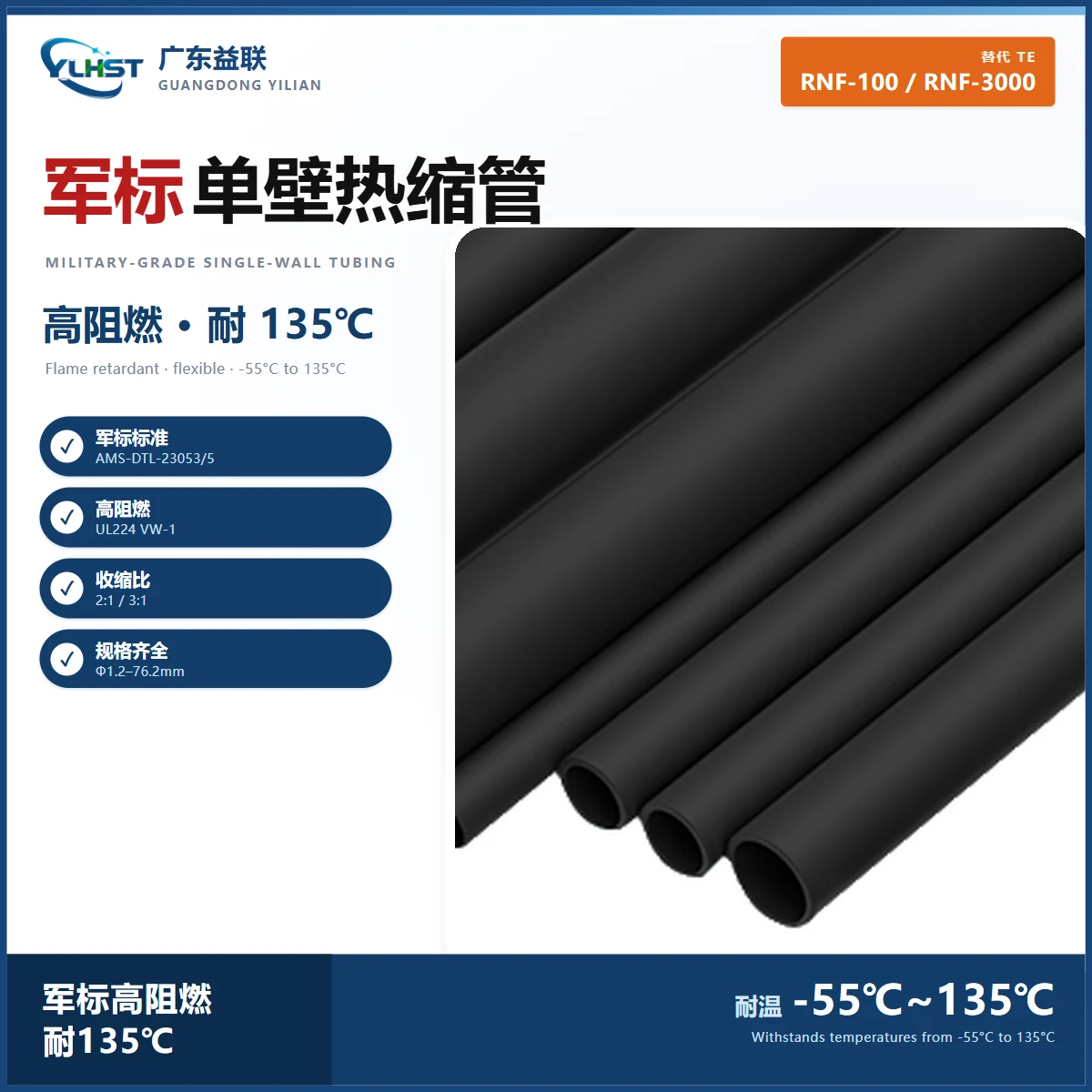
The first question on any harness line is usually "how thick a tube does this wire need?" The answer is not a single diameter. It is a sequence: shrink ratio, then inner diameter, then material. Work through those three in order and most selection problems disappear.
Step one: pick the shrink ratio
The shrink ratio compares the expanded inner diameter with the fully recovered inner diameter. The common grades are 2:1, 3:1 and 4:1. A higher ratio covers a wider range of outside diameters, which matters when the joint has a step, a terminal or a connector shell.
| Ratio | What it means | Typical use | Example |
|---|---|---|---|
| 2:1 | Recovered ID is half the expanded ID | Even bundles, general insulation | K125 single wall |
| 3:1 | Recovered ID is one third | Joints with a step, sealing | DWL-1 dual wall |
| 4:1 | Recovered ID is one quarter | Connectors, large steps, repairs | DWL-1 4:1 range |
If the protected object has a fairly constant diameter and only needs insulation, 2:1 is enough. If there is a visible step, or the joint must be sealed, go to 3:1 or 4:1 — a low ratio will leave the tube loose on the thin side and the seal will fail.
One detail is easy to miss: the ratio applies to diameter. The tube also shortens lengthwise by roughly 5–10 % when heated. Cut that allowance into the length, or the tube will not cover the joint after recovery.
Step two: size the inner diameter
Three rules cover nearly every case: the expanded ID must be larger than the largest outside diameter so the tube slides on; the recovered ID must be smaller than the smallest outside diameter so the tube grips; and roughly 10 % margin should be left for tolerances and incomplete recovery.
| Cable OD | Suggested expanded ID | Recovered ID | Note |
|---|---|---|---|
| Ø3.0 mm | Ø4.0–4.8 mm | ≤ Ø1.6 mm | About 10 % clearance to slide on |
| Ø6.0 mm | Ø7.5–8.5 mm | ≤ Ø3.0 mm | Choose 3:1 when sealing is required |
| Ø10.0 mm | Ø12–14 mm | ≤ Ø5.0 mm | Large dual-wall size for thick cable |
Step three: choose the material
Material follows the environment, not the cable size. Dry indoor insulation is a 125 °C polyolefin job. Wet, outdoor or buried joints need adhesive-lined dual wall. Engine bays and fuel systems need oil-resistant rubber such as DR150 or fluororubber such as VT200. High temperature or chemical exposure moves you to PVDF (KT175), fluororubber (VT200) or PTFE.
Flame rating is often overlooked. VW-1 is the vertical burn rating normally quoted for tubing and requires self-extinguishing within 60 seconds without flaming drips. Automotive, appliance and lighting programmes usually specify it explicitly. For the EU market, confirm RoHS 2011/65/EU compliance for the ten restricted substances and a REACH SVHC declaration, and ask for the test reports rather than a statement alone.
Step four: confirm with the four-step method
- Measure the maximum and minimum outside diameter of the protected object.
- Choose the ratio from the size change: 2:1, 3:1 or 4:1.
- Choose the size so expanded ID > maximum OD, recovered ID < minimum OD, with about 10 % margin.
- Choose the material from temperature, oil, water and flame requirements.
DWL-1 adhesive-lined dual wall covers most splice protection: 3:1 and 4:1, −55 °C to 135 °C, 2500 V/60 s withstand, built to GJB 7270-2011 and tested to the GJB 150 environmental series. For a bundle with several branches, a pre-shaped molded boot often covers a Y or T split in one part instead of three separate tubes. For very large cable, DWL-5 medium wall and DWL-6 heavy wall add mechanical strength.
Five mistakes that keep coming back
- Choosing the smallest diameter that will fit, then splitting the wall during installation.
- Checking only the recovered size and forgetting whether the tube passes over the terminal.
- Using adhesive-lined tubing indoors where no sealing is needed, and paying for it.
- Ignoring thermal margin, so the tube ages and cracks next to a heat source.
- Cutting to the exact joint length and losing coverage to longitudinal shrink.