
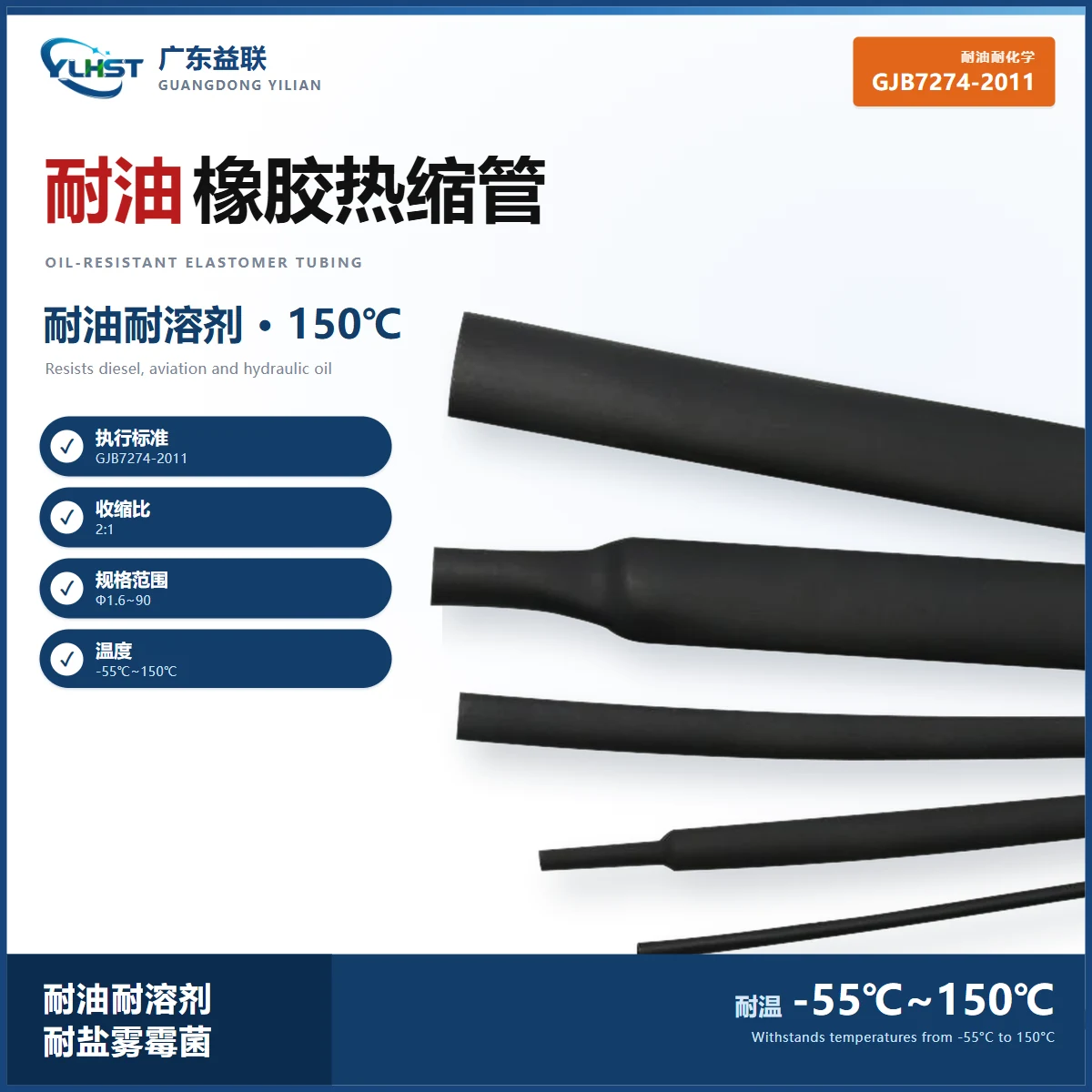
Between 135 °C and 200 °C there are four grades worth knowing. Choosing between them is not a matter of picking the highest number; each one has a different hardness, chemical tolerance and cost. The short version: general insulation goes to K135, mid-temperature oil exposure to YJDR150, a rigid wall for threading long runs to KT175, and combined heat, oil and chemical attack to YJVT200.
The four products at a glance
| Part | Material | Continuous temperature | Hardness | Positioning |
|---|---|---|---|---|
| K135 | Irradiation cross-linked polyolefin | 125–135 °C | Medium | General insulation, economical |
| YJDR150 | Oil-resistant rubber | 150 °C | Soft | Mid-temperature oil exposure, engine bays |
| YJKT175 | PVDF fluoroplastic | 175 °C | Semi-rigid | Chemical resistance, easy to thread |
| YJVT200 | Fluororubber FKM + PVDF | 200 °C | Soft and elastic | Heat, oil and chemicals together |
Start from the temperature
If the equipment never exceeds 135 °C, K135 is sufficient. At the 150 °C level with oil present, move to YJDR150. Above 150 °C and toward 175 °C, KT175 holds. Beyond that, or where heat arrives together with oil and solvents, YJVT200 is the only one of the four designed for it. Temperature is a hard threshold: choosing higher than needed costs money, choosing lower costs reliability.
Then look at environment and hardness
Once the temperature is fixed, two variables remain: the medium and the way the part is installed. For engine oil, gear oil, solvents and acids, the fluororubber construction in YJVT200 is the safest. When the tube must stay rigid to be pushed through a long conduit, KT175 is easier to handle. When it must follow a complex bundle around tight bends, the rubber elasticity of YJVT200 is the better fit.
| Item | YJVT200 | YJKT175 |
|---|---|---|
| Continuous temperature | 200 °C | 175 °C |
| Material | Fluororubber FKM + PVDF | PVDF |
| Feel | Soft and elastic | Semi-rigid |
| Best for | Complex routing in hot zones, curved surfaces | Straight runs, rigid support |
A zoned combination works best
Real projects mix the four rather than standardising on one. Around a turbine or exhaust, use YJVT200; in the mid-temperature bay, YJDR150; for identification, a printable marker sleeve; for room-temperature protection, K135. Zoning by temperature gets both performance and cost right.
YJVT200 is produced and inspected to GJB 7273-2011, the specification for flexible fluororubber heat-shrink electrical insulating sleeving. Continuous service is −55 °C to 200 °C, shrink ratio 2:1, sizes from Φ1.2 to Φ50.8 mm in 16 steps, rated 600 V, self-extinguishing within 60 seconds. Shrinking starts at 150 °C and is complete at 200 °C; install with a hot-air gun at 250–300 °C, or in an oven at 200 °C for 3–5 minutes for large sizes. After fluid immersion testing, tensile strength remains at least 11 MPa.
Writing it into a specification
Put the four numbers in the selection table — continuous temperature, medium, hardness requirement and installation method — and the conversation with a supplier becomes factual rather than comparative. When in doubt, send the harness drawing with the hot-zone marked; the choice usually follows from the drawing.